My number one tip for cooking quickly and easily / Jill Silverman Hough
Before we get to the tips, let’s get something out of the way. Is sooner better? Not necessarily. Is cooking difficult? It’s rarely difficult to do this, although sometimes it’s hard to find the time to do it.
Even so, I understand. There are days when we just want to serve food with minimal time and effort. So on days where I lean on what I have prepared. And there are usually lots to choose from.
Why? Because—and here’s a tip—it doesn’t take twice the effort to make twice the recipe.
That is, when you is make something, produce extra. Because doubling or even tripling a recipe doesn’t take double or triple the time. It takes more time, but not as much as making it all happen again. So, make a small investment now and you will be rewarded later.
With great interest.
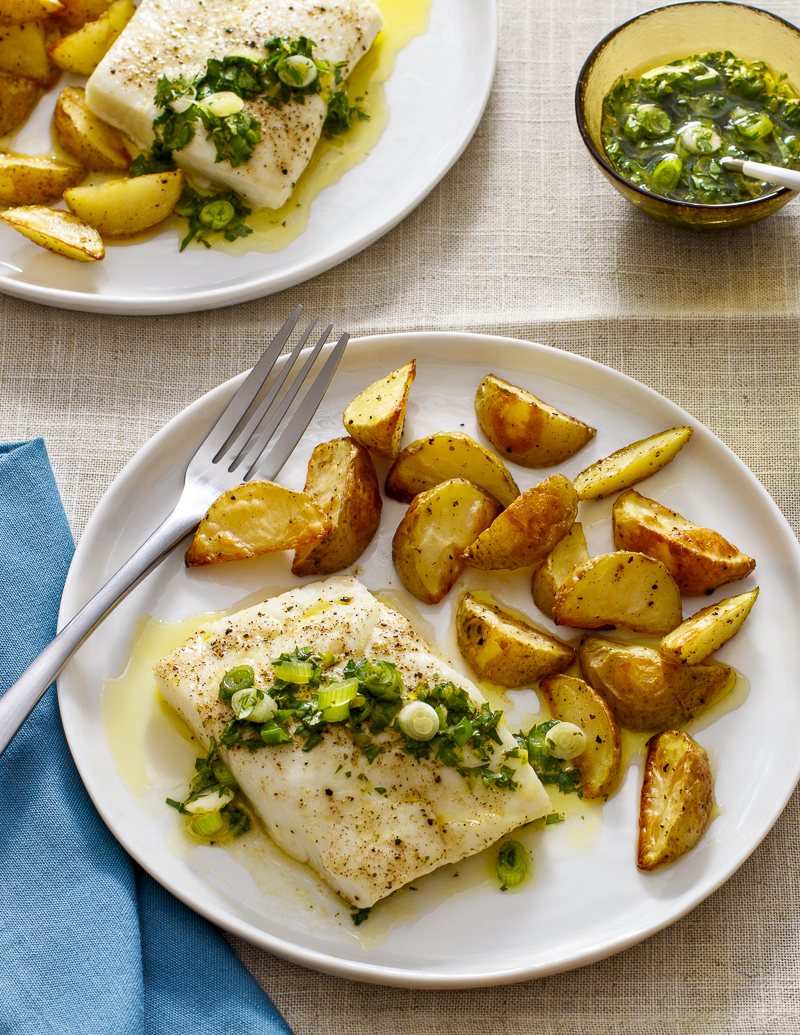
Take this Halibut and Potatoes with Cilantro-Leaf Salsa, absolutely delicious and amazing as is. But maybe you double the salsa, then dribble what you don’t use tonight onto tomorrow’s steak, chicken, roasted vegetables, or soup. Presto change-o—a once simple meal is now something fun and delicious that you can make quickly and easily for dinner.
Or maybe you double the potatoes, then add the extras over arugula topped with a fried egg for breakfast, lunch, or breakfast for dinner.
You can double halibut and enjoy its advantages as a fish sandwich. Or broken into chunks on top of a salad. (Almost every time I cook protein, I do this, because a delicious salad with a little protein is one of my favorite foods.)
Or double all three!
The fact that it doesn’t take twice the effort to make twice the recipe is very satisfying with things requiring only a minimum of slicing and dicing. In other words, for recipes that are mostly about measuring, mixing, and cooking, it takes almost no extra time to do it with a doubled recipe.
So, when you’re making a cake, for example, double the dough and then bake half. Freeze the rest, divide into balls. And the next time you need—or want :)—cookies warm from the oven, all you need to do is bake them.
I always double the recipes for muffins, scones, granola, and bread, as they are all in heavy breakfast rotation. Double now means twice as long before I have to make it again.
This may sound like I’m talking about leftovers. But that’s not all—I mean additions that serve a specific purpose, like money in the bank.
A little savings now, a lot of quick and easy cooking later.
Related reading
Things to keep in mind when doubling a recipe
Tips on how long you can freeze things and what types of food are best to freeze

PakarPBN
A Private Blog Network (PBN) is a collection of websites that are controlled by a single individual or organization and used primarily to build backlinks to a “money site” in order to influence its ranking in search engines such as Google. The core idea behind a PBN is based on the importance of backlinks in Google’s ranking algorithm. Since Google views backlinks as signals of authority and trust, some website owners attempt to artificially create these signals through a controlled network of sites.
In a typical PBN setup, the owner acquires expired or aged domains that already have existing authority, backlinks, and history. These domains are rebuilt with new content and hosted separately, often using different IP addresses, hosting providers, themes, and ownership details to make them appear unrelated. Within the content published on these sites, links are strategically placed that point to the main website the owner wants to rank higher. By doing this, the owner attempts to pass link equity (also known as “link juice”) from the PBN sites to the target website.
The purpose of a PBN is to give the impression that the target website is naturally earning links from multiple independent sources. If done effectively, this can temporarily improve keyword rankings, increase organic visibility, and drive more traffic from search results.

